Neutral-atom FT compiler demo
This page walks the strongest current end-to-end path in Quon: a typed surface-code source program is compiled into a verified neutral-atom schedule artifact, a QEC experiment JSON with a sibling Stim circuit, and an analytic resource report — from one compiler invocation.
Run it (one command)
Section titled “Run it (one command)”A fresh reviewer with the repo cloned and Devbox installed can reproduce every artifact on this page with a single command:
devbox run -- cargo run -p quonc -- examples/na_qec/surface_d3_cx.qn \ --target targets/neutral_atom/generic_rna_v0.json \ --emit-na-schedule /tmp/na-ft-demo.schedule.json \ --emit-resource-report /tmp/na-ft-demo.report.md \ --emit-qec-experiment /tmp/na-ft-demo.qec.jsonThat one compile emits four files:
| File | What it is | Evidence kind |
|---|---|---|
/tmp/na-ft-demo.schedule.json |
Neutral-atom schedule view envelope (na_schedule_view) |
analytic |
/tmp/na-ft-demo.report.md |
Compiler resource report | analytic |
/tmp/na-ft-demo.qec.json |
QEC experiment IR (dual-emit, ADR-0018) | structure |
/tmp/na-ft-demo.stim |
Sibling structure Stim circuit (noiseless) | structure |
The schedule is verified in-compiler: the run prints
quantum.na verification passed (QEC auto) (ADR-0021 auto-verifies the
quantum.na schedule for QEC-backed programs).
1. Source program
Section titled “1. Source program”The input is the executable
examples/na_qec/surface_d3_cx.qn
fixture. It allocates two distance-3 surface-code patches, runs a memory round
on each, applies a logical CX, and measures both in the logical Z basis:
-- Surface-code distance-3 logical CX via fixed-layout three-patch lattice
-- surgery (L-shaped: control|ancilla over target). Compiles on the NA/QEC
-- hybrid path (#250 / ADR-0019).

fn surface_d3_cx(): Q<Bit> = run {
        a <- surface_code<3>()
        b <- surface_code<3>()
        a <- memory_round(a)
        b <- memory_round(b)
        (a, b) <- logical_cx(a, b)
        _ <- measure_logical_z(a)
        measure_logical_z(b)
}
The linear typechecker threads each QecBlock<Surface, 3> value through the
memory rounds, logical_cx, and measurements — the same static resource
discipline the fixed gate-model path uses, applied to logical patches.
2. Emitted schedule / IR excerpt
Section titled “2. Emitted schedule / IR excerpt”The neutral-atom schedule view (--emit-na-schedule) is a large document — 255
cycle layers of trap transfers, rearrangement, Rydberg entangling stages, and
measurement rounds. Its meta + metrics envelope is the compact summary
(canonical schedule IR is quantum.na, available via --emit-na-mlir). The
metrics object below is a hand-picked subset — the real report also
carries timing keys (rearrangement_time_us, transfer_time_us,
total_time_us, …), reset_rounds, evidence_disclaimer, and a nested
error_budget (see §3), all elided here with ...:
{ "schema_version": 1, "kind": "na_schedule_view", "meta": { "target_id": "generic_reconfigurable_neutral_atom_v0", "na_backend": "zoned", "na_placer": "routing_agnostic" }, "metrics": { "evidence_kind": "analytic", "rydberg_stages": 24, "rearrangement_steps": 66, "trap_transfers": 258, "entangle2_count": 72, "measurement_rounds": 9, "estimated_cycles": 255, "bottleneck": "rearrangement", "logical_qubits": 3, "physical_atoms": 57, "atoms_per_logical": 17, "code_family": "surface_code_like", "distance": 3, "memory_rounds": 2 // ... timing (*_time_us), reset_rounds, evidence_disclaimer, error_budget } // ... "zones", "layout", and 255 "layers" elided}Numbers on this page are captured from a real run and refreshed when the scheduler changes; a fresh clone reproducing the command above should match.
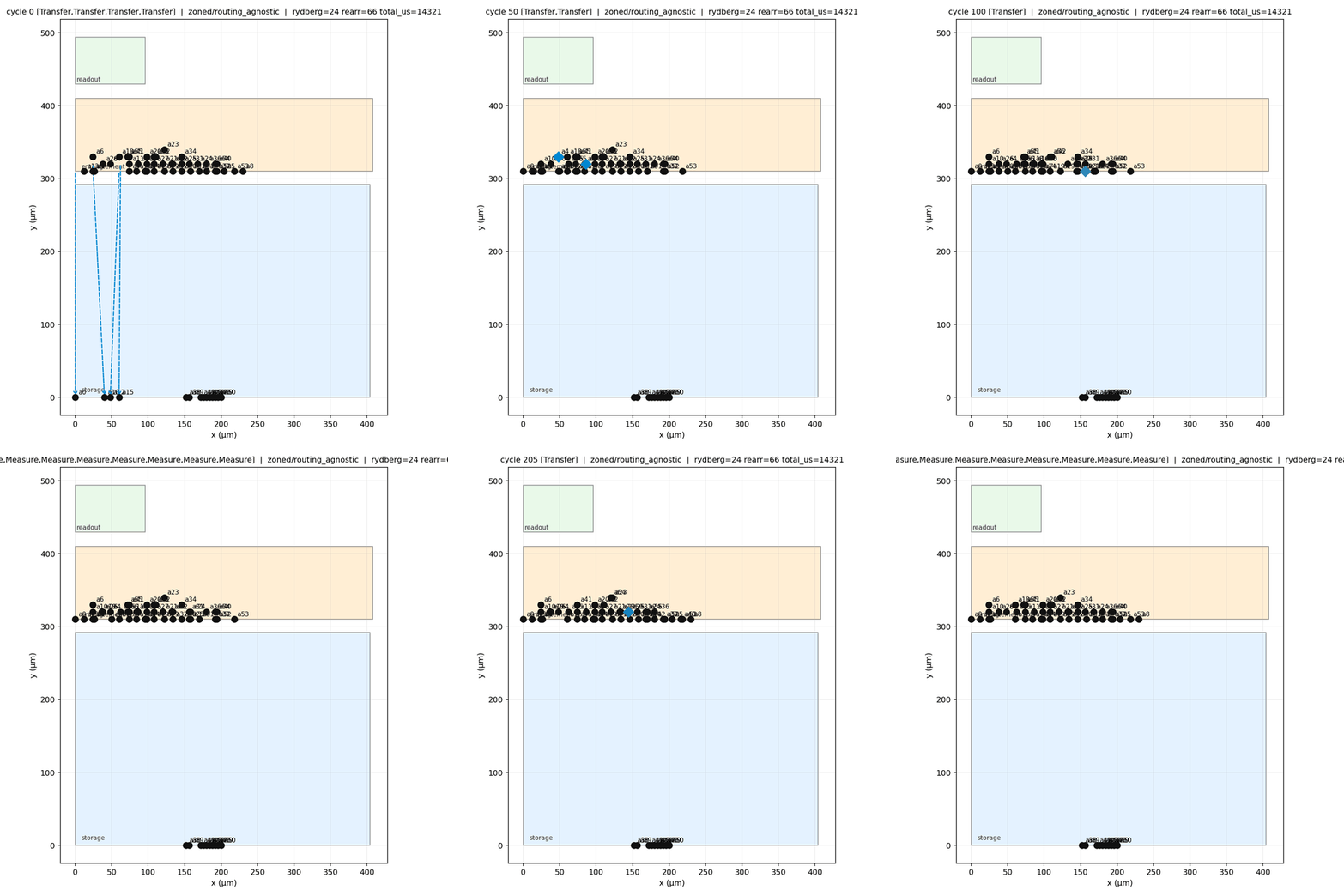
That schedule is a list of atom positions and actions per cycle — hard to
read as JSON.
python/visualize_na_schedule.py
renders each cycle as a zoned atom-trap layout (storage / entanglement /
readout regions, colored by zone, movement drawn as arrows):
devbox run -- python/visualize_na_schedule.py /tmp/na-ft-demo.schedule.json \ -o /tmp/na-ft-demo --format pngSampled frames from that run, animated:
The sibling structure Stim circuit encodes the lattice-surgery CX as
Horsman-style logical-operator MPP merges (ADR-0019). The header states the
model plainly, and byproduct Pauli-frame updates land as OBSERVABLE_INCLUDE
records rather than bare detectors:
# Quon QEC experiment — lattice-surgery CX structure (no noise; ADR-0019/0024)# family=surface distance=3 blocks=3 (L-shaped: control|ancilla / target)# Merge/ancilla outcomes → OBSERVABLE_INCLUDE via frame; not bare DETECTORs.# Stim merges use logical MPP (Horsman); NA schedules geometric seam CXs.# Note: simplified merge/split model; not Stim FT-distance claim....MPP Z0*Z1*Z2*Z34*Z35*Z36...MZ 0 1 2 3 4 5 6 7 8OBSERVABLE_INCLUDE(0) rec[-9] rec[-8] rec[-7]MZ 17 18 19 20 21 22 23 24 25OBSERVABLE_INCLUDE(1) rec[-9] rec[-8] rec[-7] rec[-21] rec[-19]# frame_z source=smooth_merge rec[-20]# frame_z source=ancilla_mz rec[-19]3. Resource report excerpt (analytic)
Section titled “3. Resource report excerpt (analytic)”--emit-resource-report writes the compiler’s analytic neutral-atom
resource report. These are schedule-derived estimates and analytic
error-budget contributions (rate × schedule count) — not sampled results:
# Neutral-atom analytic resource report
## Qubit resources| Metric | Value || --- | ---: || Logical qubits | 3 || Physical atoms | 57 || Atoms per logical | 17 || Code family | surface_code_like || Distance | 3 || Memory rounds | 2 |
## Schedule metrics| Metric | Value || --- | ---: || Estimated cycles | 255 || Bottleneck | rearrangement || Rydberg stages | 24 || Total time (µs) | 14321 |
## Physical error budget| Category | Contribution (rate × count) || --- | ---: || Rydberg | 0.048 || Measurement | 0.027 || Reset | 0.028 || Transfer | 0.1806 || Movement | 0.033 || Idle | 1.6e-8 |
4. QEC experiment excerpt
Section titled “4. QEC experiment excerpt”--emit-qec-experiment writes the QEC experiment IR (schema_version: 1,
#[serde(deny_unknown_fields)] DTO) plus the sibling .stim. The document
records the code family, distance, rounds, logical observables, the NA
schedule cross-references (na_refs), and the target error model:
{ "schema_version": 1, "kind": "qec_experiment", "family": "surface", "code_family": "surface_code_like", "distance": 3, "rounds": 2, "logical_ids": [0, 1, 2], // ... "check_graph", "measurement_schedule", "atom_site_map" elided "logical_observables": [ {"id": 0, "logical_id": 0, "basis": "z", "atoms": [0, 1, 2]} // ... one more observable for logical_id 1 (target patch) ], "error_model": { "rydberg": 0.002, "measurement": 0.003, "reset": 0.004, "movement": 0.0005, "transfer": 0.0007, "idle_per_us": 2e-09 }, "na_refs": [ /* schedule cross-references, excerpted in the next block */ ], "stim_file": "na-ft-demo.stim"}The na_refs array ties each experiment phase back to the neutral-atom
schedule, including the lattice-surgery merge/split rounds with their
barrier_cycle:
[ {"round_index": 0, "kind": "construct", "logical_id": 0}, // ... round_index 1 elided (non-contiguous excerpt) {"round_index": 2, "kind": "memory_round", "logical_id": 0, "barrier_cycle": 78}, {"round_index": 3, "kind": "memory_round", "logical_id": 1, "barrier_cycle": 157} // ... merge/split/frame_update and measure_logical refs elided]Analytic vs. sampled / decoder results
Section titled “Analytic vs. sampled / decoder results”Quon keeps these two kinds of evidence in separate artifacts and never fuses them into a single claim (ADR-0020):
-
Analytic (compiler). The resource report and schedule-view metrics above. These are derived from the schedule structure and the target error model — atom counts, cycle estimates, timing, and
rate × counterror-budget contributions. No decoder runs. -
Sampled / decoder (Python + Stim/Sinter). The structure
.stimis noiseless; sampled logical failure rates come from a separate harness that injects noise and decodes. Run it on the emitted experiment:Terminal window devbox run -- .venv/bin/python python/quon_qec_sinter.py /tmp/na-ft-demo.qec.json \--shots 10000 --seed 7 --csv /tmp/na-ft-demo.sinter.csv(Requires
devbox run -- just setup-pythononce to install Stim/Sinter into.venv.)
Analytic estimates and sampled logical failure rates are different kinds of
evidence, and neither is a threshold claim. Readers may place the files
side by side, or use the fused --emit-qec-validation report walked through
next, which does this automatically with provenance.
5. Fused QEC validation report (--emit-qec-validation)
Section titled “5. Fused QEC validation report (--emit-qec-validation)”Everything above (--emit-na-schedule, --emit-resource-report,
--emit-qec-experiment) is zero-dependency — no Python required. Quon also
has a stronger, optional end-to-end artifact that fuses the compiler’s
analytic estimates with sampled Stim/Sinter evidence into one report, with
a provenance fingerprint tying the two together
(ADR-0020 amendment #280;
full reference:
docs/neutral_atom/qec_validation_report.md).
This needs the Python/Sinter stack (devbox run -- just setup-python once) —
--emit-qec-validation shells out to python/quon_qec_sinter.py to sample
logical failures. Run it against the distance-3 surface-code memory example
(a smaller program than the CX walkthrough above, chosen to keep the excerpt
short):
devbox run -- cargo run -p quonc -- examples/na_qec/surface_d3_memory.qn \ --target targets/neutral_atom/generic_rna_v0.json \ --emit-qec-validation /tmp/na-ft-demo.validation.json \ --validation-shots 2000 --validation-seed 7 --validation-decoder pymatchingThat one command compiles, dual-emits the QEC experiment, builds the analytic
ResourceReport, samples 2000 shots through Stim/Sinter, and fuses both into
/tmp/na-ft-demo.validation.json (+ a sibling .md rendering) — while still
writing the underlying primaries (*.qec.json, .stim,
*.resource_report.json, *.sampled.json) as separate sibling files, per
ADR-0020. The .md rendering below is captured verbatim from a real run —
analytic and sampled evidence in clearly labeled sections, tied together by a
provenance fingerprint:
## Provenance
| Field | Value || --- | --- || Source | `examples/na_qec/surface_d3_memory.qn` || Distance | 3 || Rounds | 2 || Experiment SHA-256 | `4dbcec439c3474c7e5401c6e3dab302d782c71948d8f45fa419eb7910d390242` |
## Analytic evidence*evidence_kind: `analytic`*
| Metric | Value || --- | ---: || Logical qubits | 1 || Physical atoms | 17 || Estimated cycles | 165 || Rydberg stages | 16 |
## Sampled evidence*evidence_kind: `sampled`*
- Decoder: `pymatching` · Seed: 7 · Confidence level: 0.95
| Shots | Logical failures | Failure rate | 95% CI (Wilson) || ---: | ---: | ---: | :--- || 2000 | 6 | 0.003 | [0.0014, 0.0065] |
provenance.experiment_sha256 ties the sampled row back to the exact compiled
*.qec.json bytes; fusion refuses (or, with --allow-sampled-mismatch,
warns) if attached sampled data doesn’t match the compiled artifact. As
always: 6 failures out of 2000 shots at one seeded noise-model working point
is validation evidence, not a threshold claim.
Current limitations
Section titled “Current limitations”This demo is deliberately scoped. What it does not do:
- No threshold claim. Neither the analytic report nor any sampled Sinter run on this page asserts an error-correction threshold.
- Scoped lattice surgery. The logical CX is a simplified Horsman-style
three-patch gadget at
d = 3(ADR-0019), lowered through a scoped patch-operation planner with fixed L-shaped geometry. There is no general patch router or arbitrary patch placement, and the geometric seam schedule alone is not a Stim-equivalent FT-distance claim. - Scoped surface-code schedule. The end-to-end path is validated for the distance-3 surface code; other odd distances are expected to extend but are not part of this verified slice.
- No proprietary hardware model. The target is the generic reconfigurable
neutral-atom descriptor
generic_rna_v0.json, not any vendor’s calibrated device model. - Non-Clifford logical operations are a resource-accounting model, not yet
compiler-reachable from source. Magic-state-consuming logical
T,T†, andCCZexist at the QEC-workload layer (issue #283): aWorkloadBuilderAPI, expansion into magic-state rounds, resource-report fields (t_count,tdag_count,ccz_count,magic_state_demand), and QEC experiment / Stim-comment emission. This is strictly consumption — magic states are assumed already available and are never produced. There is no distillation factory, and T/CCZ are recorded as metadata rather than expanded to physical gates. The frontend typechecker does not yet bindlogical_t/logical_tdag/logical_cczas source identifiers, soquonccannot compile a.qnprogram that uses them end-to-end yet (tracked in #311). The logical operation demonstrated on this page (logical_cx) remains Clifford.
Where this fits
Section titled “Where this fits”- ADR-0018 — QEC experiment dual-emit (
.qec.json+ sibling.stim). - ADR-0019 — simplified lattice-surgery CX.
- ADR-0020 — analytic reports and sampled results stay separate.
- ADR-0021 — auto-verify
quantum.naon QEC programs. docs/neutral_atom/qec_validation_report.md— full--emit-qec-validationreport schema and provenance/mismatch handling (#280).docs/neutral_atom/magic_state_operations.md— what the magic-state-consuminglogical_t/logical_cczmodel does and does not do (#283).- The neutral-atom pedagogy pack and the quonc CLI reference cover the schedule model and emission flags in more depth.